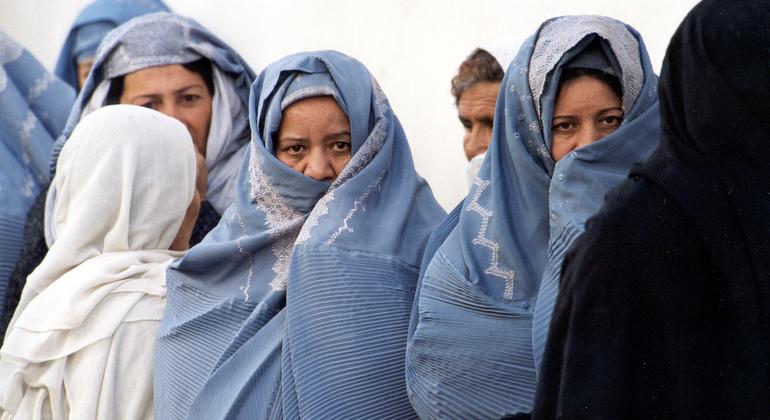
A group of UN rapporteurs and experts* declared this Monday that the Taliban continue to violate numerous human rights, and highlighted the application of a system of total discrimination, exclusion and subjugation of women and girls. Furthermore, the gap between the promises and practices of de facto authorities has widened.
“Two years ago, the Taliban seized power in Afghanistan. Since then, the policies they have imposed on the Afghan population have resulted in a continuous, systematic, and egregious violation of numerous human rights , including the right to education, work, and the freedoms of expression, assembly, and association,” the experts stated.
Furthermore, they expressed concern about the numerous reports of summary executions and acts equivalent to enforced disappearances , widespread arbitrary detentions, torture and ill-treatment, as well as arbitrary displacements.
Experts point to women and girls, ethnic, religious and other minorities, people with disabilities, displaced people, LGBTQ+ people, human rights defenders and other civil society actors, journalists, artists, educators and former government and security officials as those most affected.
total domination
“Despite assurances from the de facto Taliban authorities that any restrictions, particularly regarding access to education, would be temporary, the facts on the ground have demonstrated the existence of a system of segregation, marginalization, and persecution ,” they stressed.
Furthermore, the Taliban have intensified their efforts to subject women and girls to total domination , prohibiting them from working and attending school if they are over 10 years old in several provinces of the country.
More generally, the promises of a more inclusive form of government have not materialized : the amnesty for former government officials and military personnel is being violated, and lawyers, judges, prosecutors, and other agents connected to the legal system face serious security risks.
“The de facto authorities have introduced the use of cruel and inhuman punishments , such as stoning, flogging, and burial under a wall, in contravention of international human rights standards. The concept of a ‘reformed’ Taliban has proven to be misguided,” the rapporteurs said.
Call to the Taliban
Therefore, they urged the Taliban to allow all women and girls to enjoy all human rights , including freedom of movement and participation in political and public life, access to education and work.
They also called for full respect for the declared general amnesty and an end to arbitrary detentions, enforced disappearances, torture, and ill-treatment. In this regard, to monitor places of detention, the authorities must allow free and unimpeded access to human rights observers and humanitarian workers.
They also recommended reversing the actions that have led to the reduction of civic space.
Need for humanitarian aid
Human rights experts noted that the unstable economy, the erosion of livelihoods, drought conditions and other climate disturbances have also put the social, economic and cultural rights of Afghans under pressure and increased the need for humanitarian aid.
In this regard, they estimate that 16 million Afghan children do not receive basic food or essential healthcare for their well-being and development. The economic recession fuels harmful, discriminatory, oppressive, and violent practices, such as forced and child marriage, abuse and economic and sexual exploitation, the sale of children and body parts, forced and child labor, human trafficking, and unsafe migration. The ban imposed on Afghan aid workers from working for NGOs has also impacted the effectiveness of the humanitarian response.
Despite the deteriorating situation, they warn of " critical funding shortfalls" for their humanitarian response . This could lead to the disruption of community classes, a reduction in food aid, and the closure of health facilities, among other consequences.
They also fear that these conditions and lack of employment opportunities can lead to detrimental coping mechanisms, such as joining criminal or armed groups.
Many Afghans continue to leave their homes out of desperation. While those who host them are to be commended, many refugees reside in desperate circumstances.
Call to the international community
Given these circumstances, the group of experts asked the community to ensure that political engagement with all Afghan interlocutors is focused on human rights.
Regarding the gender perspective, they called for refugee status to be granted to all Afghan women and girls due to violations of their fundamental rights.
They also urged addressing the funding shortfall in the humanitarian response plan and devising ways to provide aid that reaches the Afghan people directly and supports investigation and accountability mechanisms and tackles impunity.
Finally, the experts called to support the initiatives of Afghan women leaders and civil society groups operating inside and outside the country to explore practical ways to promote the values and principles of human rights.
* The experts: Richard Bennett, Special Rapporteur on Afghanistan ; Mary Lawlor, Special Rapporteur on the situation of human rights defenders; Fernand de Varennes, Special Rapporteur on minority issues; Irene Khan, Special Rapporteur on freedom of opinion and expression; Reem Alsalem, Special Rapporteur on violence against women and girls; Dorothy Estrada Tanck (Chair), Ivana Radačić (Vice-Chair), Elizabeth Broderick, Meskerem Geset Techane and Melissa Upreti, Working Group on discrimination against women and girls; Ana Peláez Narváez, Chair of the Committee on the Elimination of Discrimination against Women; Alexandra Xanthaki, Special Rapporteur in the field of cultural rights; Paula Gaviria Betancur, Special Rapporteur on the human rights of internally displaced persons; Tomoya Obokata, Special Rapporteur on contemporary forms of slavery, including their causes and consequences; Morris Tidball-Binz, Special Rapporteur on extrajudicial, summary or arbitrary executions; Fabián Salvioli, Special Rapporteur on the promotion of truth, justice, reparation and guarantees of non-recurrence; Michael Fakhri, Special Rapporteur on the situation of human rights defenders worldwide; Ana Peláez Narváez, Chairperson of the Committee on the Elimination of Discrimination against Women; Michael Fakhri, Special Rapporteur on the right to food; Priya Gopalan (Chairperson-Rapporteur), Matthew Gillett (Vice-Chairperson for Communications), Ganna Yudkivska (Vice-Chairperson for Follow-up), Miriam Estrada-Castillo, and Mumba Malila, Working Group on arbitrary detention; Farida Shaheed, Special Rapporteur on the right to education; Margaret Satterthwaite, Special Rapporteur on the independence of judges and lawyers; Alice Jill Edwards, Special Rapporteur on torture and other cruel, inhuman or degrading treatment or punishment, Víctor Madrigal-Borloz, Independent Expert on sexual orientation and gender identity, Aua Baldé (Chair-Rapporteur), Gabriella Citroni (Vice-Chair), Angkhana Neelapaijit, Grażyna Baranowska, Ana Lorena Delgadillo Pérez, Working Group on enforced or involuntary disappearances.
**The experts are part of what is known as the Special Procedures of the Human Rights Council . Special Procedures, the largest body of independent experts in the UN human rights system, is the general name for the Council's independent investigative and monitoring mechanisms that deal with specific country situations or thematic issues in all parts of the world. Special Procedures experts work on a voluntary basis; they are not UN staff and do not receive a salary for their work. They are independent of any government or organization and serve in their individual capacity.