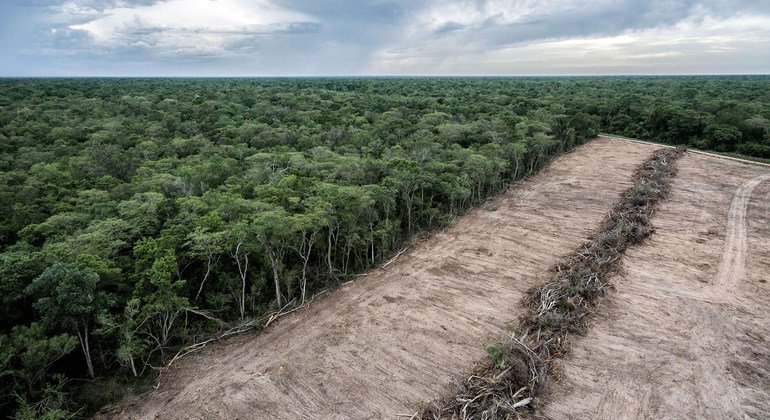
A new study by the United Nations Office on Drugs and Crime ( UNODC ), published this Monday, shows that forest crime is interconnected with other types of illegal activities , such as illegal mining, human trafficking and drug trafficking, which exacerbates the damage to the environment, communities and the economy.
Forest Crimes: Illegal Deforestation and Logging , the second part of the Global Analysis of Environmental Crimes , offers a global view of the state of knowledge of forest crimes, with special attention to market dynamics and the criminal actors behind illegal deforestation and logging.
“Our study shows that perpetrators of forest crimes are often involved in other types of crime, from drug and wildlife trafficking to illegal mining and child labor,” said Angela Me, Head of Research and Analysis at UNODC.
“They can also be legitimate companies looking for shortcuts to increase their profits.”
Increase profits, increase influence and gain territorial control
Organized crime groups may engage in forestry crime to increase their profits or increase their influence and territorial control.
In South America, these groups launder their drug trafficking profits through land speculation, agriculture, and livestock. Meanwhile, in the Congo Basin and Somalia, politically motivated organized crime groups have sold and taxed charcoal produced from illegally logged forests.
In some parts of Latin America, organized criminal groups are involved in a range of illicit activities that go beyond drug trafficking and have a significant negative impact on the environment and create hotspots of violence.
The Amazon Basin is a region where drug trafficking organizations perpetrate crimes that affect the environment beyond deforestation.
Forestry crimes infiltrate legal processes
According to the study, forest crimes infiltrate legal processes and supply chains , making them difficult to repress.
Illegally logged timber, for example, enters legal markets through fraudulent permits, bribery, and regulatory loopholes, often with the help of corrupt officials and complicit companies, allowing it to be laundered into the global economy.
In addition to timber companies, other industries have also been investigated for illegal deforestation and logging. A Latin American official has claimed that construction companies deforest and clear roads, then allow illegal logging, as revealed in a recent case in South America.
Regulations can have unintended consequences
The overlap of crimes “exacerbates the already devastating effects of forest crime and underscores the need for a coordinated approach, stricter regulations and rigorous enforcement to effectively combat these interconnected threats to our biodiversity, economy and global security,” Me said.
The report notes that: “Combating forest crimes, such as illegal deforestation and logging, is essential to ensuring the protection and sustainable management of forests.”
Forest crime regulation has had both successes and unintended consequences. Measures targeting demand for timber can reduce illegal supply. However, these regulations can also cause illegally sourced timber to move to another geographical location.
Suppliers may also simply switch to logging other types of trees to avoid the administrative burden of trading in protected species like rosewood.
The study emphasizes that policy frameworks must respond to the evolution of illegal strategies and be systematically evaluated to fill regulatory gaps.