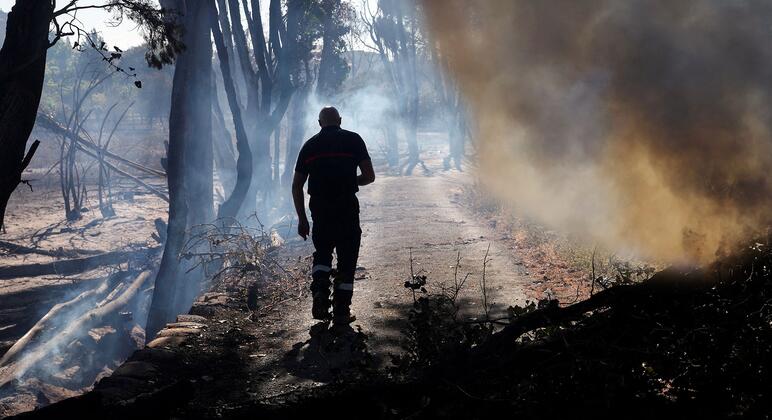
The sweltering summer in Europe is not just a seasonal heat wave; we are facing a stark reality: the beginning of a new and dangerous climate era.
What is happening in the waters of the Pacific is triggering a domino effect that threatens to destabilize global health, the economy, and peace.
Climate monsters awaken
The World Meteorological Organization ( WMO ) confirms it: a strong El Niño phenomenon is in full development and will reach its peak between August and October 2026. Pacific waters are registering temperatures almost 3°C above normal, a historical record for this time of year.
But El Niño doesn't act alone. It's joined by the Indian Ocean Dipole, another weather pattern that's disrupting rainfall thousands of kilometers away. The result is a fractured global map: while some regions of Africa, Central Asia, and southern Europe brace for torrential rains and flooding, the Indian subcontinent, Central America, the Caribbean, and southern Australia face severe droughts.
However, heat and drought are only half the equation. Climate change is acting as a threat multiplier in an already fragile world.
The rehearsal is over
We've spent decades treating each heat wave, each wildfire, and each drought as isolated tragedies. But the science of July 31, 2026, screams at us that it's a systemic risk.
Extreme heat is no longer a future threat; it's our everyday reality. It's breaking records, stifling economies, and silently claiming lives.
In Guterres' words: 'The dress rehearsal is over.' His warning is clear: we cannot afford to stand idly by waiting for the main event, because this is already the stark reality. The only way to survive is to act now, protecting the most vulnerable and tackling the root of the crisis once and for all. The world cannot afford to wait any longer.
When the weather turns harsh and war suffocates
The impact of this "planet on fire" is felt particularly acutely in the markets and on the tables of the most vulnerable families. Guterres, after visiting the Middle East, painted a bleak picture: the military escalation in the Gulf has paralyzed trade in the Strait of Hormuz. Fuel, food, and fertilizer prices have skyrocketed.
The World Food Programme warns that up to 45 million people could face acute food insecurity. When you add a historic drought fueled by El Niño to supply chains disrupted by war, the cocktail is lethal for emerging economies.
The heat and the smoke kill.
The heat and smoke from the fires kill thousands of people without them appearing as victims.
The devastating fires that have ravaged areas of Spain, France, and Greece this summer teach us that the danger is not only the flames, but the air we breathe.
The World Health Organization ( WHO ) warns that smoke from wildfires can travel across entire continents. It is composed of a toxic mixture of gases and fine particulate matter (PM2.5). These particles are so microscopic that they penetrate deep into the lungs and enter the bloodstream.
“ If you can smell the smoke, it’s in the air you’re breathing ,” experts warn. For people with asthma, heart disease, children, and the elderly, exposure can be fatal, even if the fire is hundreds of kilometers away. As a Greek photojournalist covering the fires recounts, “The most important thing is to understand that the wind can change; suddenly, the smoke hits you and you can’t breathe.”
Heat inequality: Who pays the price?
Extreme heat amplifies existing inequalities. While the wealthy can afford air conditioning and working from home, billions of people do not have that option.
Outdoor workers, the homeless, children, and the elderly bear the brunt of the heat. The WHO is focusing on the garment industry: more than 90 million workers, mostly women, endure long days in factories where dangerously hot days have increased by 10% in the last two decades . As the UN message aptly summarizes: "No one should have to risk their life to earn a living."
Shields and solutions: How to survive this harsh reality
Faced with this landscape of "uncharted territory," resignation is not an option. The good news is that the decisions we make today will define the impacts of tomorrow.
At the global and governmental level:
- Early warning systems: The WMO is mobilizing the global community to ensure that climate predictions reach farmers and governments on time. Data saves lives.
- Heatwave action plans: Cities must adapt their urban planning, create "climate refuges" and protect vulnerable populations.
- The end of fossil fuels: This is the root of the problem. Every new oil, gas, or coal project is fuel for the next fire.
At an individual level , if you live in an area affected by fires or heat waves, the WHO recommends:
- Monitor air quality and follow the alerts of local authorities
- Take shelter indoorsKeep doors and windows closed. If you have air conditioning, set it to recirculation mode (without bringing in outside air).
- Protect your breathing: If you must go out, you must wear high-protection masks (FFP2 or N95).
- Beware of the indoor heatDo not use fans that bring in outside air. Do not smoke, do not burn wood, and avoid frying food to prevent further saturating the air in the house.
- Adapt the routine: If it is extremely hot, reduce physical activity and seek out the coolest rooms in the house, especially at night.