The fighting between January and May of this year forced tens of thousands of people to flee their homes in Sudan's Blue Nile State, most of them women and children. Many are now in displacement camps where violence, frequent flooding, and damaged infrastructure make it difficult to access basic health services, including prenatal and delivery care.
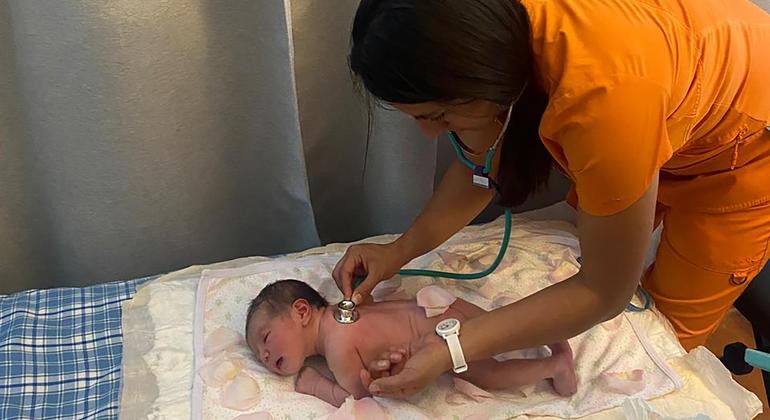
To address this situation, the United Nations Population Fund ( UNFPA ) has deployed and equipped 15 midwives in the communities where they are most needed . One of them is Sa'aida, who also had to leave her home in 2024 and currently works in a mobile clinic supported by the agency in the Al Karama 3 camp in Ad-Damazin, the state capital.
“Some women gave birth along the way,” Sa’aida told UNFPA. In those circumstances, she explained, the midwives had to provide emergency care with the resources available. Without trained personnel, some women could have suffered severe hemorrhaging with fatal consequences for both them and their babies.
A sense of security amidst the displacement
The presence of a midwife within the camp allows women to receive care without having to find a health center on their own or incur expenses that many displaced families cannot afford. Somaya, one of the women attended by Sa'aida, explained that she had no money and didn't know where to seek medical services after arriving at the camp.
“Without her, I would have suffered terribly,” she recounted. “We have no money and we don’t know where to go or how to access health services here.” For Somaya, having Sa’aida in the camp “has given us a sense of security.”
Another of the deployed midwives, Safya, keeps a record of the pregnant women and where they live. If any of them miss their appointments, she goes to find them herself to find out what happened. Most of the women give birth within the camp, but Safya identifies pregnancies that may have complications and arranges for their transfer to the hospital when she believes there is a risk.
This was the case with Al Radyyia, a mother of eleven, who arrived at the camp in the late stages of her pregnancy. When labor began and the contractions intensified, she called Safya. The midwife recognized that it was a high-risk birth and arranged for her transfer to the maternity hospital in Ad-Damazin, where she was able to give birth safely.
Safya continued to visit her every two days after the birth to check on the mother and baby. Both are doing well. “She truly saved my life, and I am deeply grateful for the care and support she gave me,” Al Radyyia said.
Much more than assisting in childbirth
The work of midwives does not end with birth. They can provide a large part of the essential sexual and reproductive health services, from family planning guidance and pregnancy support to detecting obstetric emergencies, supporting survivors of gender-based violence, and offering health education.
In Safya's case, monitoring begins in the third month of pregnancy and continues until after delivery. Midwives also distribute essential medicines and provide postpartum care to breastfeeding mothers. However, working within the camps presents additional difficulties, especially during the rainy season, when travel becomes more complicated and quickly transporting a patient to the hospital can be challenging.
The situation is exacerbated by the fact that many health facilities in Sudan remain closed, leaving displaced women without stable and safe access to maternal care. UNFPA maintains mobile clinics and safe spaces in various parts of the country, although some have had to close due to funding cuts.
140 safe deliveries in three weeks
The initial results demonstrate the impact this type of care can have. In just the first three weeks of deployment, midwives supported by UNFPA assisted 140 safe births and provided follow-up care to more than 700 pregnant women.
With support from the Norwegian government, the organization is also training another 30 midwives in White Nile State and 30 more in North Kordofan, who will be deployed to respond to the growing maternal and reproductive health needs in crisis-affected areas.
UNFPA also facilitates transfers to the Ad-Damazin maternity hospital for cesarean sections and provides financial assistance and vouchers for other complicated deliveries. The camp also has an isolation ward for pregnant women with hepatitis E, designed to ensure specialized care amid deteriorating sanitation conditions.
Lack of funding threatens the response
The need for these services remains enormous. By 2026, UNFPA had requested $129,2 million to address urgent sexual and reproductive health needs and respond to gender-based violence in Sudan. As of August, however, it had received only about a third of the necessary funding.
In a country where war has displaced millions and numerous health centers have ceased operations, investing in midwives is one of the most effective and sustainable ways to protect the health of mothers and newborns. Experience in Blue Nile shows that having a trained professional readily available to women can allow for the timely detection of complications, facilitate emergency transfers, and, in some cases, make the difference between life and death.