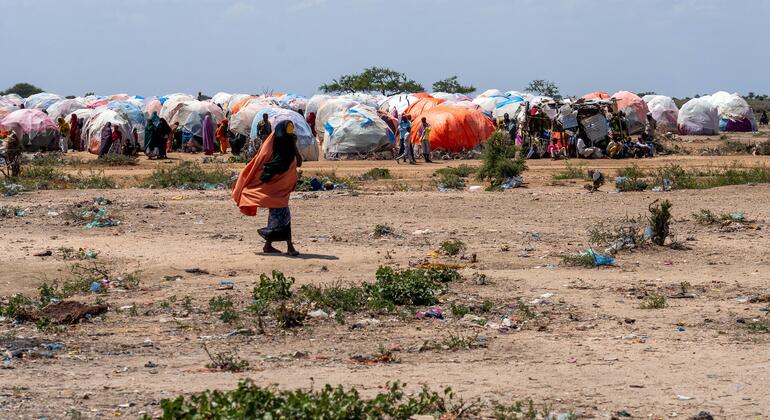
Amid the worsening food crisis in Somalia, artificial intelligence (AI) is helping to deliver aid to those who need it most.
Although the UN World Food Programme ( WFP ) cannot reach all six million Somalis suffering from hunger, data collected by its partners and analyzed using AI tools on the HungerMap Live hunger monitoring platform allows the agency to position resources in specific areas before the situation worsens.
Somalia suffers from droughts caused by climate change , followed by flash floods, in addition to a conflict that has lasted 35 years and caused hundreds of thousands of deaths.
The Horn of Africa country also imports most of its food, making it especially vulnerable to fluctuations in international prices, such as those resulting from the current conflict in the Middle East.
In June, the WFP and the United Nations Food and Agriculture Organization ( FAO ) added Somalia to the list of "hunger hotspots of highest concern" , along with northeastern Nigeria, Sudan, South Sudan, Yemen and Palestine.
"The situation is extremely serious and I am very worried about the coming weeks and months," said Simon Renk, WFP's vulnerability, analysis and mapping officer in Somalia .
Artificial intelligence in Burhakaba
In the Burhakaba district, located about 180 kilometers northwest of Mogadishu, health centers are treating numerous children with severe malnutrition.
WFP humanitarian workers identified the urgency of the situation thanks to the artificial intelligence tools integrated into HungerMap Live.
With that information, the agency provided food assistance to 48.000 people and nutritional support to 3000 women and children.
"Instead of waiting for child malnutrition to worsen and cause displacement or even death, we were able to anticipate it," Renk explained.
A familiar technology with new potential to save lives
First launched in January 2020 to monitor food security in more than 90 countries, HungerMap Live is a publicly accessible platform that uses data on food insecurity, climate, economy, agriculture, inflation and other indicators to show areas where food insecurity already exists or where it could worsen.
Although the first version used artificial intelligence to estimate food insecurity levels in data-scarce countries, it had a limited capacity to predict future crises and did not assess the nutritional quality of diets.
That changed with HungerMap Live 2.0. The new version, launched by the WFP in April, completely revamped the interface and incorporated AI-powered predictive features, enabling governments and WFP offices to act before a crisis escalates.
"This new version not only helps us describe where hunger exists, but also to explain why conditions are worsening and where they might deteriorate next ," Renk noted.
Although the platform's data does not replace on-the-ground assessments, it helps the WFP team in Somalia to determine which communities should receive help first and what type of assistance is most appropriate, whether it be cash aid or specialized nutritional support.
Prioritize aid
In a country where six million people suffer critical levels of food insecurity , the WFP can only assist one in ten people in need.
According to Renk, the WFP office in Somalia needs an additional $192 million between now and January 2027 to reach the entire population that requires assistance.
In the face of insufficient resources, artificial intelligence-based tools help decide which communities should be prioritized and reduce the time between early warning and humanitarian response.
AI enables the WFP to analyze predictive data on rainfall deficits, flood risk, market prices, conflicts, and nutrition to anticipate where the next food crisis might occur, making it easier for governments to take preventative measures and for the WFP and its partners to position the necessary aid in advance.
Every minute counts
"This platform and the various solutions are not intended to make hunger a more technical or abstract problem. The key is to shorten the time between an early warning and a decision that allows us to protect a family or an individual before the situation becomes irreversible," said Simon Renk.
However, he stressed that using artificial intelligence to support decision-making does not solve the main problem: the majority of Somalis who need help will still not receive it.
"AI helps us set priorities with a more solid evidence base," he concluded. "But that doesn't make the lack of resources to respond to needs acceptable."