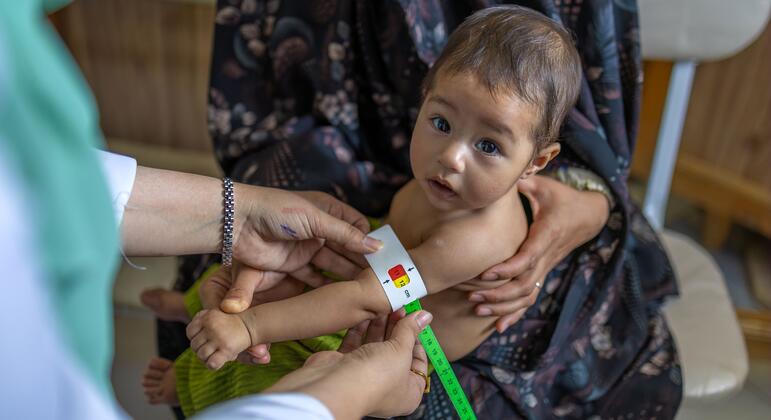
Child malnutrition has reached critical levels in 12 provinces of Afghanistan , roughly a third of the country, as funding cuts force reductions in feeding and treatment programs precisely when they are most needed. The World Food Programme ( WFP ) warns that the situation will continue to deteriorate in the coming months unless assistance is urgently scaled up.
The most recent nutrition alert shows that the situation worsened in 26 of the 34 provinces compared to 2025, even before the period when malnutrition typically peaks, between July and September. In total, 3,7 million children are projected to suffer from acute malnutrition in 2026, along with 1,2 million pregnant and breastfeeding women.
The concern was reinforced on Tuesday by the United Nations Office for the Coordination of Humanitarian Affairs ( OCHA ). Officials there noted that child wasting has worsened this year in more than three-quarters of the country and that too many children arrive at health centers already suffering from severe malnutrition. Others cannot even access treatment due to the vast distances, difficult terrain, and damaged roads in some of the most remote provinces.
Hunger strikes even during harvest time
Child malnutrition typically increases in Afghanistan during the summer and early autumn due to a rise in communicable diseases, poor water and sanitation conditions, reduced access to nutrition services, and food insecurity. This year, however, many children were already suffering from hunger even during the months of greatest food availability.
Food insecurity among children increased from 40% in the third quarter of 2025 to 47% in the first quarter of 2026 , and is closely linked to cases of acute malnutrition. The situation is especially worrying among children under two: nearly 90% live with food insecurity, and approximately half are in severe food poverty.
“The faint cries of malnourished babies haunt health clinics in Afghanistan, as worried mothers, many weakened by hunger, bring their children in desperate search of treatment,” said WFP Country Director John Aylieff. “We are watching the next generation wither away even though this is harvest time, a time of abundance. It is not only heartbreaking, it is unacceptable,” he added.
The youngest among those most affected
Children under two years old account for a disproportionate number of the most severe cases. According to the alert, they represent 83% of cases of severe acute malnutrition and 77% of cases of moderate acute malnutrition. Nearly 40% of infants under six months old admitted to hospitals present with severe malnutrition accompanied by medical complications.
Of the 3,7 million children who could suffer from acute malnutrition this year, some 942.000 are expected to have severe cases , while more than 700.000 are projected to have moderate forms considered high-risk. The alert warns that, without a rapid expansion of preventive interventions and treatment, the situation could worsen even further during the remainder of 2026.
Sediqa's story reflects the situation of many families. A mother of seven, she collects nutritional supplements from the World Food Programme for two of her daughters, ages three and 18 months. Their family's diet consists mainly of bread and tea. "We don't have any other food," she explains. "We don't have nutritious food like potatoes, rice, beans, or legumes because we are poor." Her husband works odd jobs and earns around three dollars a day when he can find work and his health allows it. Half of that money goes toward rent.
Fewer clinics and less aid
The crisis is worsening as available services dwindle. In 2025, 142 health centers closed , leaving more than 13.000 children without nutritional treatment. This year, the remaining programs have also suffered shortages of specialized products due to conflicts in the Middle East and the nine-month closure of the border with Pakistan.
Disruptions to supply routes left nearly one million mothers and children without essential nutrition services for five months , according to the WFP. This was compounded by a 31% reduction in centers providing early intervention for cases of moderate acute malnutrition.
The lack of funding is affecting the entire humanitarian response. The plan for Afghanistan requires around $1700 billion , but, well into August, it has received barely more than 26% of the necessary resources. OCHA described the situation as alarming, especially because indicators such as malnutrition continue to worsen while nutrition, health, and education programs have had to scale back their activities.
Insufficient funding is also forcing a reduction in food distribution. Between April and September, 13,8 million people are projected to face severe food insecurity , but between May and July, the WFP was only able to assist 5% of those in need.
Only one in seven will receive help
Financial shortfalls also directly threaten treatment. The alert warns that only one in seven children and women with acute malnutrition will be able to receive assistance from the World Food Programme (WFP) this year. UNICEF , for its part, faces difficulties funding the treatment of 575.000 children with severe or moderate malnutrition at high risk, while the WHO lacks sufficient resources to care for some 35.000 children with serious medical complications.
The World Food Programme (WFP) maintains that prevention remains the most effective, sustainable, and cost-efficient tool to prevent the situation from worsening, but it currently lacks the funding to sustain these programs. The agency needs $540 million over the next six months to expand food and nutrition assistance. “Afghanistan is already experiencing one of the world’s most severe and persistent malnutrition crises, and these figures could rise even further,” Aylieff warned.
Disease, unsafe water, and malnutrition feed off each other.
The lack of an adequate diet is not the only factor behind the decline. Diseases, low vaccination coverage, and limited access to clean water and sanitation are also increasing the risk of malnutrition. Cases of acute diarrheal diseases increased by 12% during the first quarter of 2026 compared to the same period of the previous year. Furthermore, although national measles vaccination coverage has reached 83%, 14 provinces remain below the 80% target.
These difficulties are compounded by droughts, floods, earthquakes, and other phenomena that repeatedly strike families already living in precarious conditions. OCHA noted that many communities barely have time to recover from one emergency before facing the next, and that each new shock pushes them even deeper into poverty.
Although security has improved in some parts of the country, humanitarian officials warn that security does not necessarily equate to human security: it does not put food on the table, replace crops lost after a drought, or bring a doctor to a malnourished child living in a remote community. For millions of Afghans, daily life remains marked by hunger, poverty, and uncertainty.
The alert calls for the restoration of nutritional services in the most affected provinces, the rapid expansion of preventative interventions, the guarantee of an uninterrupted supply of therapeutic products, and the acceleration of vaccination, water, sanitation, and hygiene measures. Without these actions and sufficient funding, the agencies warn, more children and women will face preventable illnesses, severe malnutrition, and deaths.