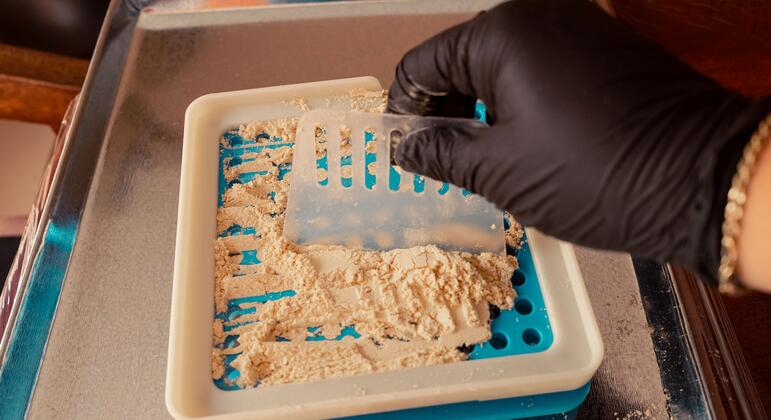
The International Narcotics Control Board (INCB) has identified 14 types of equipment legally used in sectors such as the pharmaceutical, chemical, food and cosmetic industries that can also be diverted to manufacture illicit drugs.
These include industrial machines for mixing substances, equipment for carrying out and controlling chemical reactions, and machinery capable of compressing powders to manufacture medicines, supplements, or even certain types of candy, but which can also be used to produce illicit drug pills. Other equipment allows substances to be encapsulated, a technology commonly used in the manufacture of medicines and supplements.
These devices also have legitimate applications in the veterinary industry and in hospitals, laboratories, universities, and research centers. Their widespread use and the possibility of a single machine having multiple uses pose one of the main challenges for authorities: preventing them from falling into the hands of illicit manufacturers without hindering legitimate trade or industrial and scientific activities.
A new INCB assessment provides the first comprehensive analysis of the industries and actors involved in the manufacture, marketing, and distribution of these devices. The aim is to offer governments a basis for understanding how these devices circulate, identifying vulnerabilities, and strengthening cooperation with manufacturers, distributors, and other private sector stakeholders.
Equipment that can last for decades
Unlike the chemical precursors used to manufacture drugs, which are typically consumed or transformed during the production process, machines can be used repeatedly, sold, moved, refurbished, and exported multiple times throughout their lifespan. This means that knowing only the original manufacturer and buyer is insufficient to guarantee traceability.
Therefore, the INCB broadens its focus to the entire supply chain. In addition to manufacturers, importers, and distributors, it identifies logistics companies, intermediaries, second-hand dealers, machinery reconditioning companies, digital platforms, and services responsible for dismantling, recycling, or destroying equipment once it is no longer in use.
The challenge has become more relevant with the expansion of synthetic drug manufacturing, which may require more complex and specialized machinery than that traditionally used to produce plant-based drugs such as cocaine or heroin.
The second-hand market, a vulnerable point
The buying and selling of used machinery plays an important role for small and medium-sized enterprises, research institutions, and startups seeking more economical alternatives. Refurbished equipment can cost between 30% and 60% less than new equipment , which explains the expansion of this market and the extended lifespan of many machines.
However, as equipment changes ownership, information about its origin, maintenance, and destination can be lost. The INCB notes that industrial auctions present particular challenges, as machinery may be traded with limited documentation on previous owners, maintenance history, or compliance with regulatory requirements.
Digital platforms add another dimension. These marketplaces have facilitated legitimate access to new, used, and refurbished equipment and allow buyers and sellers from different countries to connect more quickly. At the same time, they multiply the ways in which machinery can circulate internationally, increasing the importance of having adequate traceability mechanisms.
From medicines to food
The breadth of the market explains the difficulty in monitoring these products. Tablet presses and encapsulating machines, for example, are essential for pharmaceutical production, while evaporators, condensers, and reaction vessels are widely used in laboratories, chemical industries, and research centers.
Other sectors are less obvious. The supplement industry uses machinery similar to that used in pharmaceuticals to produce vitamins, minerals, and other products in tablet or capsule form, while some candy factories use presses to make compressed candies. In the food sector, certain equipment is used to concentrate extracts and essences, process ingredients, or control the temperature of products such as honey, oils, and fats.
The size of these markets is also considerable. Estimates compiled by the INCB place the global market for encapsulating machines at around $2780 billion , for mixing equipment at $2500 billion , and for tablet presses at $1600 billion , reflecting the enormous legitimate circulation of machinery that can also be used illicitly.
3D printing opens a new challenge
The INCB also warns of an emerging trend: 3D printing . This technology already allows for the manufacture of certain equipment components, including some parts for tablet presses, using relatively inexpensive devices and digital files.
For now, attempts to produce illicit tablets using 3D-printed equipment have been limited to basic, low-capacity designs, far from the performance of industrial machinery. However, advances in metal printing, materials strength, and mechanical precision could allow for the manufacture of more sophisticated components in the future.
This poses a particular challenge to traditional control systems, which rely on monitoring international trade, sales, and the physical movement of machines. Manufacturing from digital files could allow certain parts to be produced locally, without them having to cross a border or navigate a conventional supply chain.
More cooperation with the private sector
The INCB believes that the answer lies in strengthening cooperation between governments and companies involved in each stage of the chain, from manufacturing and distribution to resale and final disposal of the equipment.
The aim is not to restrict machinery used daily by legitimate industries, but to improve the visibility and traceability of its movement in order to detect potential diversions . This publication thus constitutes a first step in a broader initiative to help national authorities work with the private sector and strike a balance between facilitating legitimate trade and reducing opportunities for illicit drug manufacturing.