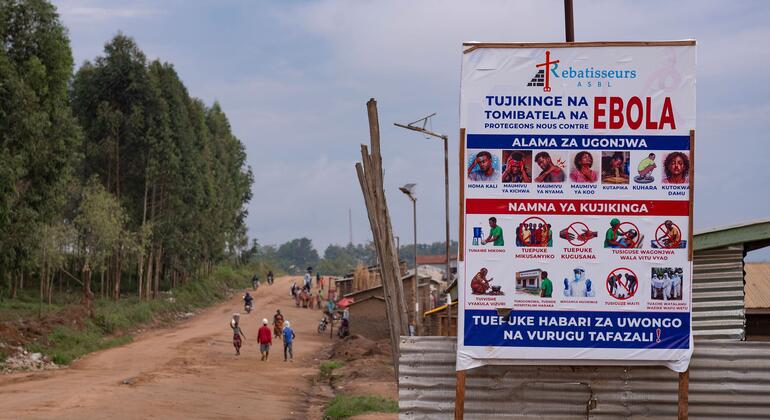
The Ebola outbreak caused by the Bundibugyo virus in the Democratic Republic of Congo has become the second largest ever recorded and the fastest spreading to date, the World Health Organization ( WHO ) warned on Tuesday.
Nearly 5000 people have been infected and more than 2300 have died in six provinces and 55 health zones, according to WHO Director-General Tedros Adhanom Ghebreyesus, who acknowledged that, three months after the epidemic was declared a public health emergency of international concern, the situation remains extremely serious.
“We must be frank: the epidemic is far from being under control,” Tedros said during the second meeting of the Emergency Committee of the International Health Regulations.
The rapid spread of the virus is being driven by a particularly difficult combination to contain: insecurity, travel, and intense movement of people along roads, rivers, and mining routes. Cases have now reached a sixth province, Bas-Uele.
The transmission chains that are not yet visible
Many deaths continue to occur in homes, communities, or health centers that are not specialized in treating Ebola. Some of these individuals are also not among the known contacts of previous cases.
According to Tedros, each of those deaths could be a sign of a still unidentified chain of transmission.
"Until every chain is found and cut, the epidemic will continue," he warned.
The case fatality rate is around 46%, according to the latest official data cited by the WHO.
To try to find these cases sooner, the organization is reinforcing surveillance with 100 additional epidemiologists, who will work alongside more than 500 community workers in contact tracing, detecting possible infections and referring patients early to treatment centers.
Capacity to care for them is also being expanded. In the last two weeks, more than 400 beds have been added in various affected locations.
Motorcyclists, part of the surveillance
But detecting infections doesn't depend solely on doctors and epidemiologists. In many of the affected areas, motorcyclists are the ones who transport sick people and even corpses between communities. This work has made them one of the groups most exposed to the virus, but also a potentially important resource for identifying new cases.
The WHO began by providing them with handwashing stations and disinfectant products. Now it wants to go further and incorporate them directly into epidemiological surveillance.
The idea is that they can alert health teams when they transport a sick person, so that the person can be located, examined and, if necessary, quickly transferred to a treatment center.
The WHO's field response officer, Thierno Baldé, explained to reporters from Bunia that some motorcyclists have directly suffered the consequences of the epidemic and recounted the case of a man who had lost six members of his family.
“We want to go further and count on them as surveillance and response agents,” he said.
Community participation is now one of the pillars of a response that also seeks to involve women's associations, political leaders, and local authorities.
Insecurity and distrust
This effort takes on special importance in a context where insecurity and resistance from some communities continue to complicate the work of healthcare teams.
On Monday, one of the ambulances used in the response was attacked in Bunia. Baldé explained that this is not an isolated incident.
“We face some kind of reaction from the communities almost daily,” he said, describing situations in which families who are losing loved ones must simultaneously accept rapid and difficult health measures.
The teams are trying to return, engage in dialogue with the communities, and rely on local authorities and organizations to regain trust and continue operations.
Despite these difficulties, there are some signs of progress. Baldé noted that localities that six or seven weeks ago were registering a high number of deaths in the community are now showing some stabilization, with fewer cases and a faster capacity to intervene.
Vaccines and treatments are advancing
While efforts are underway to curb transmission on the ground, medical tools are also advancing against a variant of the virus for which there is still no specifically approved vaccine.
For the first time, two vaccines designed against the Bundibugyo virus have entered human clinical trials, Tedros reiterated.
A third vaccine has shown cross-protection in animal studies and is preparing to move into a phase three trial. In addition, the WHO-sponsored PARTNERS trial, which is studying potential treatments, already has 100 patients enrolled.
However, Tedros cautioned that scientific advances alone will not be enough. The response requires faster data sharing, increased monitoring, sustained funding, safe access to affected areas, and closer cross-border coordination.
So far, the WHO has received about $69,3 million of the $115 million it needs for its operations, leaving a gap of about $46 million.
Risk of international spread
Tedros warned that the risk of international spread remains high, as population movements can carry the virus from one country to another.
Uganda managed to stop transmission after the first cases linked to the outbreak, while last month a case was detected in France in a traveler from the affected region.
“Borders can slow the spread, but not stop it,” the WHO director general said.
Therefore, the Organization considers it essential to strengthen surveillance and coordination between countries to quickly detect new cases and prevent new chains of transmission from being established.
Tedros also noted that Ebola is spreading in communities already facing other serious health problems, including malaria, cholera, pneumonia, diarrheal diseases and high maternal mortality.
The response to the outbreak, he stressed, must be intensified without disrupting the population's access to other essential health services.