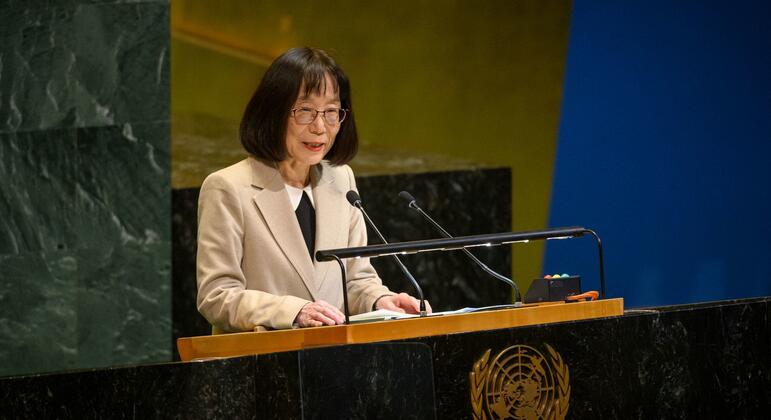
The International Criminal Court (ICC) deplored the announcement of the new round of US sanctions against its president and a senior prosecutor, calling them “a blatant attack” on the court.
“These sanctions constitute a blatant attack on the independence of an impartial judicial institution that acts under the mandate conferred upon it by its States Parties from different regions,” the Court said in a statement.
The Court, established in 2002 under the Rome Statute, is an independent institution and is not part of the United Nations. The Security Council , however, can refer cases to the court.
With the consent of the countries that have signed the Statute, the Court prosecutes individuals for genocide, war crimes, crimes against humanity, and the crime of aggression.
UN spokesman Stéphane Dujarric told reporters on Wednesday that Secretary-General António Guterres was “seriously concerned” about the latest US move, as well as the continued sanctions against other Court employees.
The United States intensifies its offensive
The United States, which is not a party to the Rome Statute, fears that the court could prosecute American citizens for serious crimes allegedly committed in countries that, unlike Washington, recognize the Court's authority.
On Tuesday, US Secretary of State Marco Rubio announced new sanctions against the Chief Justice of the Supreme Court, Tomoko Akane, and Chief Trial Prosecutor Abdoulaye Seye. Washington had already sanctioned former Chief Prosecutor Karim Khan, who was subsequently removed from his post.
According to press reports, Seye has participated in the investigation into Israeli funding of illegal settlements in the West Bank and the alleged distribution of weapons to settlers.
In November 2024, the Court, under the direction of prosecutor Khan, issued arrest warrants against Israeli Prime Minister Benjamin Netanyahu and former Defense Minister Yoav Gallant for alleged war crimes related to the war against Hamas in Gaza.
The sanctions come on top of those previously imposed by the U.S. against the Court during President Donald Trump's two terms, as well as Rubio's July 13 statements that the United States intended to "dismantle" the "threat" the court poses to U.S. sovereignty.
Nine of the Court's 18 judges, along with its two assistant prosecutors, the former prosecutor and a staff member, are now prohibited from conducting transactions with U.S. citizens and are subject to significant restrictions in the global financial system.
The Court is “a fundamental pillar” of international criminal justice
“Although the United Nations and the International Criminal Court are separate institutions with distinct and differentiated mandates, as we have said on numerous occasions, the United Nations considers the ICC to be a fundamental pillar of international criminal justice and the Secretary-General deeply respects its work,” Dujarric stated.
For its part, the Office of the High Commissioner for Human Rights stated that the new sanctions are “unacceptable” and must be lifted.
“ Volker Türk reiterates his call on States to stand up for the institutions they themselves have created to promote and defend human rights and the rule of law, and to protect Court officials who are targeted by such reprisals,” the Office said in a social media post .
In its response, the Court stressed that “the international legal order itself is at risk” when judges are threatened for applying the law.
“Threats and coercive measures also affect the ability of victims to seek justice, as they turn to the Court only when all other avenues have been exhausted,” he noted.
The court stated that it stands with its staff and the victims of “unimaginable atrocities” and added that it will continue to fulfill its mandate with independence and impartiality.
He said he values the constant displays of solidarity from States Parties, civil society and all those who support the rule of law and justice for victims of international crimes.
“The Court will continue its work, with all its partners and with the unwavering support of its States Parties, to ensure the effective and independent implementation of its mandate,” he concluded.