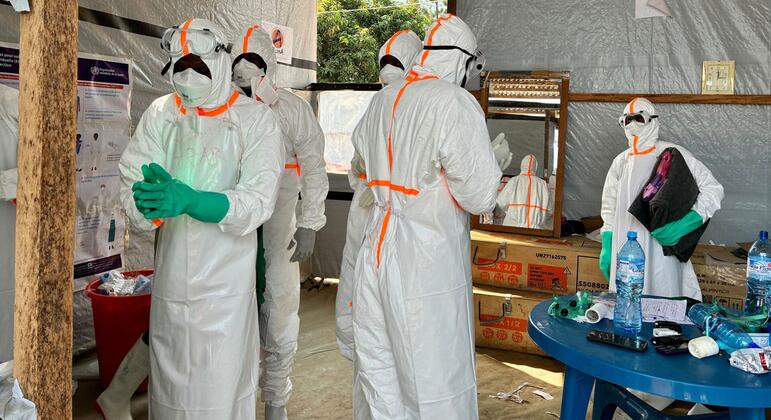
As the Ebola outbreak continues to spread at an unprecedented rate in the Democratic Republic of Congo (DRC), the World Health Organization ( WHO ) is calling for a humanitarian truce of at least six months to allow medical teams to reach exposed populations and regain control of transmission.
In Addis Ababa, the diagnosis of the director of the World Health Organization's (WHO) regional office for Africa is straightforward: the tools to combat Ebola exist, but a portion of the affected populations remain beyond the reach of health teams.
"The challenge today does not lie in knowledge or tools," declared Dr. Mohamed Yakub Janabi at the opening of the 76th session of the Regional Committee for Africa.
For the UN health agency, access to communities is now the main obstacle to the response. Therefore, it is calling on all parties to guarantee a humanitarian truce of at least six months so that medical teams can intervene "safely and without hindrance in the affected communities."
" When we manage to reach the populations, we stop the transmission. When we can't, the virus continues to spread ," Dr. Janabi insisted.
The WHO attributes the worsening situation to persistent insecurity, a consequence of decades of armed conflict that have weakened the rule of law and social services and led to the displacement of more than one million people.
To double or triple the capabilities
According to the latest figures from August 21, 2026, the DRC had recorded 5514 confirmed cases and 2642 deaths across 57 health zones. The epidemic is now considered the second largest ever recorded and the fastest-growing.
The day before, Dr. Janabi had already spoken of a "decisive turning point," considering that transmission was now outpacing efforts to combat it.
Faced with this escalation, those responsible for the response are calling for a change in scale. In a joint statement, Dr. Janabi, WHO Director-General Dr. Tedros Adhanom Ghebreyesus, and Africa CDC Director-General Dr. Jean Kaseya called for reaching every affected area, protecting frontline workers , and turning commitments into concrete actions.
"These efforts must be scaled up even further. We must double or triple the current response capabilities, in all its components," they stated.
Protecting healthcare workers has also become an urgent matter. As of August 20, 158 healthcare professionals had been infected and 45 had died.
Trace every case, break every chain
In affected or high-risk areas, health facilities must have, among other things, trained staff, protective equipment, clean water, and effective infection prevention and control systems.
For the WHO and Africa CDC, the priority remains identifying every case, tracing every contact and breaking the chains of transmission , while strengthening cross-border coordination and international support to "leave no community behind."
These objectives now translate into a series of recommendations aimed at strengthening the response and limiting the risk of spread beyond the areas already affected.
Following its emergency committee meeting last week, the WHO published on Monday the recommendations made by its director-general. These recommendations call on Kinshasa, among other things, to strengthen its entire response system, from case surveillance and care to community mobilization, monitoring of movement and gatherings, and the protection of healthcare workers.
Gatherings and movements under surveillance
For the first time, the WHO is also calling on the DRC to facilitate the deployment of international health teams and the shipment of necessary equipment , in particular by streamlining immigration and customs clearance procedures.
It also recommends investigating all deaths that occur outside of treatment centers to detect possible links with transmission and to better understand the reluctance of some communities to provide safe and dignified burials.
The WHO also maintains the epidemic as a public health emergency of international concern . It considers the regional risk to remain "high" for neighboring countries, while it remains "low" for other states.
To reduce the risk of transmission, the agency recommends that the DRC strengthen mobility monitoring and postpone large gatherings in transmission zones. It also recommends reducing density in leisure venues, reinforcing health checks on roads, facilitating a safe reopening of schools, and limiting motorcycle travel to a single passenger.
Finally, enhanced surveillance is recommended for ships connecting the affected areas with major urban centers, especially Kinshasa.
For the WHO, the challenge now is to win the race against the virus: reaching communities, protecting those who care for them, and breaking the chains of transmission before Ebola spreads further.