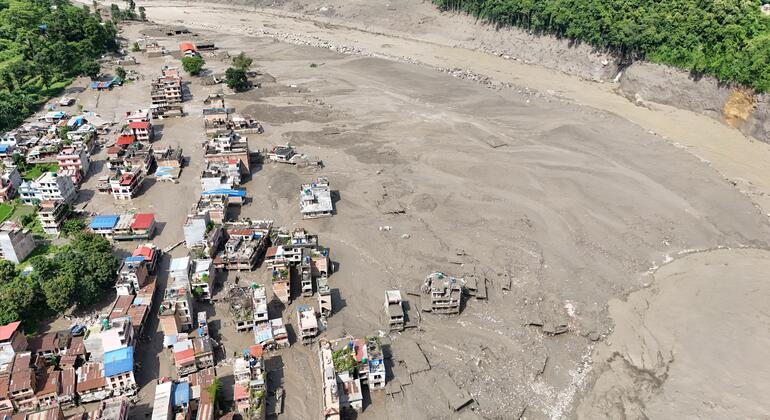
On Thursday, the full extent of the destruction remained difficult to assess. Hundreds of people were still missing in Nepal and China after torrents of water and mud swept through several Himalayan valleys the previous day, leaving some communities cut off from the rest of the world.
A particularly vulnerable region
UN Secretary -General António Guterres expressed his solidarity with the victims and their families on Wednesday. The tragedy strikes a region that has repeatedly suffered the effects of deadly natural disasters.
In April 2015, a magnitude 7,8 earthquake killed more than 8800 people in Nepal and devastated numerous mountain communities. In October 2025, torrential rains again triggered floods and landslides in the east and center of the country, affecting more than 30.000 people.
These new floods come as the UN warns of the rapidly increasing risks associated with extreme weather events. The United Nations Office for Disaster Risk Reduction ( UNDRR ) estimates that the world could experience 560 medium- to large-scale disasters per year by 2030.
"The number of disasters worldwide is expected to increase by 40% between 2015 and 2030, as a result of climate change and a systematic underestimation of risks," the organization warns.
According to the UNDRR, the true cost would already amount to $2290 billion per year if, in addition to the directly documented damages, indirect effects and damage to ecosystems are taken into account. In the Himalayas, where populations live at the foot of glaciers, on unstable slopes, and in hard-to-reach valleys, this week's events dramatically highlight this vulnerability.
In Nepal, at least 359 people have died and hundreds remain missing, according to police. In China, hundreds of people also remain missing, and at least three deaths have been confirmed. Search and rescue operations are ongoing, so these figures could change rapidly. The United Nations office in the country reported a significant number of casualties and damage in the Tibet Autonomous Region. In Nepal, the districts of Rasuwa, Nuwakot, and Dhading are among the worst affected, with displaced families and disrupted essential services.
The United Nations Central Emergency Response Fund ( CERF ) has released an initial tranche of two million dollars “to save lives through emergency medical care, shelters and water,” announced Tom Fletcher, head of the UN Office for the Coordination of Humanitarian Affairs for emergency relief operations, on X.
Fletcher is also in contact with Nepalese and Chinese authorities and with United Nations teams in the region. On Thursday, he met with, among others, Nepalese Foreign Minister Shisir Khanal, to whom he offered UN support and conveyed his condolences.
For its part, the UN office in Nepal indicated that “ United Nations agencies are deployed in the affected areas with food, medical supplies and emergency equipment to support the government-led response, and are prepared to do more.”
Isolated valleys
The Rasuwa district, located about 80 kilometers north of Kathmandu, has been one of the hardest hit. Among the affected towns are Timure, Rasuwagadhi, and Syabrubesi. The latter is situated at the entrance to the Langtang Valley, a popular destination for hikers, mountaineers, and pilgrims.
A high-altitude glacial calving event is among the possible causes of the floods that swept away homes, roads, and bridges. However, the exact circumstances of the disaster still need to be clarified.
One of the immediate challenges is precisely assessing the scale of the disaster. Rescue teams must reach communities that have become inaccessible by road, while the United Nations analyzes satellite imagery of the affected areas to pinpoint the damage and guide operations. Difficult access, communication outages, and logistical constraints are complicating rescue efforts. With numerous roads and several bridges destroyed, much of the operation must now be conducted by air.
The consequences are especially severe for children : according to the UN Children's Fund ( UNICEF ), at least 17.000 children have been affected in Nepal . In the flooded areas, families have lost their homes, access to water, and healthcare.
The World Health Organization ( WHO ) has deployed emergency medical teams with enough medicines and supplies to provide basic care to 10.000 people. Six multi-purpose tents have also been sent to maintain health services in areas where infrastructure has been damaged.
“These supplies are intended to support health professionals on the front lines who continue to provide essential care and respond to the immediate health needs of affected populations,” the WHO explained.
The World Food Programme ( WFP ) and UNICEF also planned to begin deploying staff and trucks loaded with emergency equipment this Thursday.