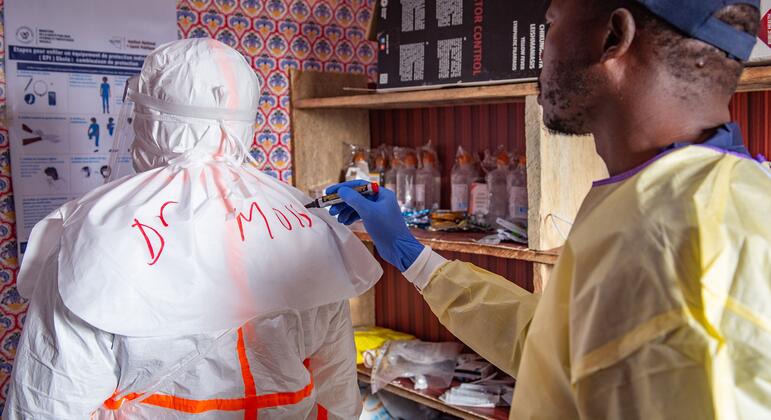
Time is of the essence. In New York, the UN Secretary-General placed the Ebola crisis in the Democratic Republic of Congo (DRC) at the center of a press conference, offering a blunt diagnosis.
"This is the fastest-growing epidemic ever recorded," António Guterres reminded reporters at a press conference. "It is advancing faster and spreading more widely than the response designed to contain it. But it can be stopped."
As of August 25, 5713 cases had been confirmed in the DRC, and 2744 people had died from the disease. Around 500 new infections are now being reported each week, with women and children being the most affected. The epidemic has become the largest ever recorded in the country.
The paradox is that the means to combat Ebola are known. Detection and isolation of the sick, epidemiological surveillance, treatment, safe burials: the tools to interrupt transmission exist.
“We know how to contain Ebola, how to interrupt transmission, and how to save lives,” the senior official insisted. But, according to him, we must also combat “another virus: the virus of indifference.”
Resources for "weeks, not months"
This indifference translates first into a lack of resources. The $2130 billion humanitarian plan presented to address the crisis is only 48% funded, despite, according to Guterres, a significant contribution from the United States. The UN has mobilized more than $80 million through its common funds, but the available resources will only allow operations to continue for "weeks, not months ."
The Secretary-General is therefore calling for an additional $1100 billion. "Without additional funding, vital operations will run out of money just when they need to increase their capacity," he warned.
Money, however, is only part of the problem. Ebola is spreading in a region where decades of conflict have displaced entire populations and weakened health infrastructure. In Ituri province alone, one million people have been displaced in 30 years. More than 12 million people in the region need humanitarian aid and protection.
Insecurity directly hinders the response. More than 40 healthcare professionals have lost their lives , while treatment centers and ambulances have been attacked. Humanitarian teams must simultaneously confront the virus and violence, while some communities remain difficult to access.
Despite the magnitude of the crisis, some signs of improvement are emerging. On Wednesday, the WHO 's emergencies director for Africa, Marie Roseline Belizaire, said the rate of spread had slowed, although it had not yet reversed.
"Its spread has slowed, but the epidemic curve has not yet flattened," he stated. In total, 58 health zones across six provinces remain affected.
Uganda manages to break the transmission
The contrast with Uganda is striking. On Thursday, the World Health Organization (WHO) and the Africa Centres for Disease Control and Prevention (Africa CDC) announced the end of the epidemic in the country, after 42 days without any new confirmed cases since the last patient was discharged from the hospital on July 16.
Uganda has recorded 20 cases since the start of the epidemic on May 15: 15 imported from the DRC and five locally transmitted among contacts and healthcare workers. Two patients have died and 18 have recovered. More than 800 contacts have been identified and monitored.
For the WHO, this result demonstrates that close surveillance, early detection, and community mobilization can break the chains of transmission. But it also underscores the difficulty of replicating this strategy in eastern DRC, where war and population displacement significantly complicate access to patients.
The threat remains regional. The Congo River and major transportation routes connect millions of people and communities. The UN is strengthening preparedness and coordination with South Sudan and the Central African Republic, while the WHO continues to advise against any restrictions on travel and trade.
" We will not be safe until transmission has stopped everywhere ," summarized Jean Kaseya, director general of the Africa CDC.
For António Guterres, the obstacle is no longer the available knowledge, but the will to deploy it on the necessary scale. "The world has the knowledge, the means, and the resources needed to stop this epidemic," he declared. Action is needed, he warned, before the cost becomes "more deadly, more difficult, and higher."