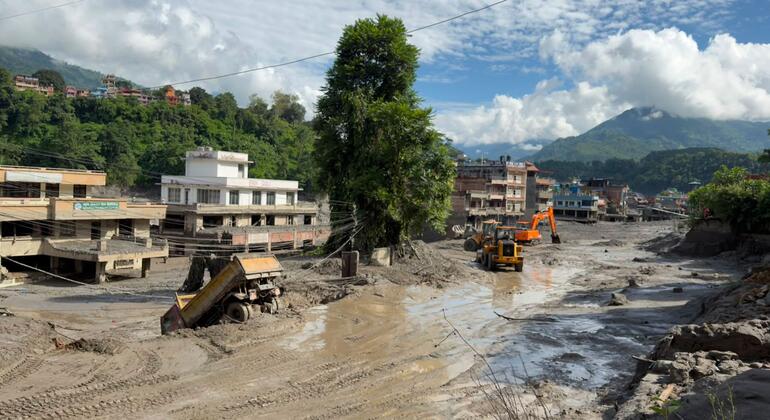
The risk of further flooding in northern Nepal remains high enough to force humanitarian teams to suspend some of their missions. The UN Resident and Humanitarian Coordinator in the country, Lila Pieters Yahia, confirmed this on Friday morning.
He had been in a disaster-affected area for about an hour, assessing needs, when he received an alert on his phone and had to cut short his visit to return to Kathmandu.
“We had only been on the ground for an hour and we had to turn around and return to Kathmandu,” he declared during a UN press conference in Geneva.
Entire communities isolated
On the ground, humanitarian teams are still trying to reach isolated communities in the districts of Rasuwa, Nuwakot and Dhading, which were hit by deadly floods on Wednesday.
According to Pieters Yahia, 977 people are still missing in Nepal and 538 bodies have been recovered, according to the National Disaster Risk Reduction and Management Authority.
The Tibet Autonomous Region in China has also been affected, with some 560 people missing.
The scale of the destruction is considerable. Some 40 kilometers of roads have been completely destroyed, and another 40 bridges have been destroyed or severely damaged . Some areas are now only accessible by helicopter, "so everything is being transported by air, even drinking water," explained the humanitarian coordinator.
A disaster of exceptional magnitude
According to Kamal Kishore, head of the United Nations Office for Disaster Risk Reduction (UNDRR), a disaster of this magnitude had not been seen in mountainous areas "for a very long time."
“To our knowledge, we have never experienced a mountain hazard-related event of this magnitude,” he said, referring to the serious consequences for “human lives, livelihoods, buildings, infrastructure, bridges, hydroelectric projects and electricity generation.”
According to Kishore, the tragedy also serves as a reminder of "how fragile the ecosystem of mountainous areas is" and highlights the importance of having effective early warning systems.
“The disaster is not completely over yet,” Kishore insisted, urging people not to underestimate the risks that remain.
Nearly 93.000 people affected
The International Federation of Red Cross and Red Crescent Societies estimates that nearly 93.000 people may have been affected by the floods that struck the border region between Nepal and Tibet on Wednesday. The organization fears the death toll will rise.
Thousands of homes have been destroyed or severely damaged, while dozens of roads, bridges and other essential infrastructure have suffered significant damage.
17.000 children urgently need help
“At least 17.000 children urgently need humanitarian assistance,” said Ricardo Pires, spokesman for the UN Children’s Fund ( UNICEF ).
In several locations in Rasuwa and Dhading, the daily lives of children changed in a matter of moments: their homes, schools, and health centers were damaged or destroyed.
Many have also lost family members. According to UNICEF, some 10.000 children living in the affected areas need support to continue their education.
The UN agency is appealing to mobilize $17,2 million to maintain its emergency response and support the early stages of recovery.
For its part, the World Health Organization ( WHO ) has sent emergency medical supplies intended to cover the needs of nearly 10.000 people for three months, in addition to tents and body bags.
Six health centers have been damaged in Rasuwa and Dhading and eight health professionals remain missing, according to the WHO.
The health agency warns that population displacements and overcrowding caused by a disaster of this magnitude could disrupt water, sanitation and health services, thus increasing the risk of the spread of infectious diseases.