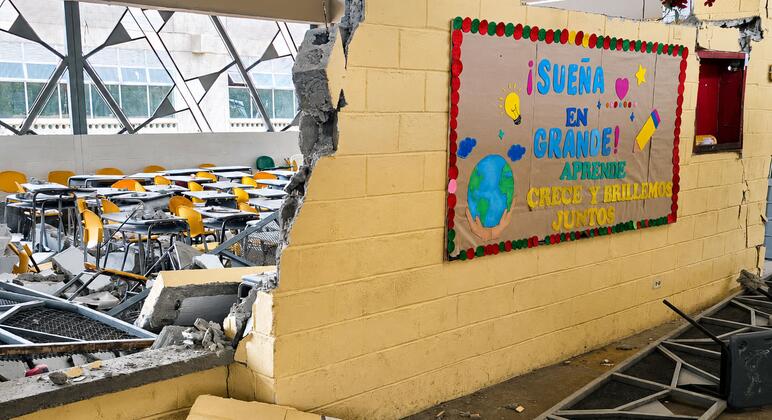
The UN warned on Friday that the earthquake in Colombia could worsen the risk of child recruitment in Chocó and Valle del Cauca, where thousands of children remain out of school in areas where illegal armed groups operate.
The earthquake affected more than 3800 schools and has impacted the education of over one million students. Approximately 178.000 students attend schools that suffered severe structural damage.
The United Nations Resident Coordinator in Colombia, María José Torres Macho, recalled that the recruitment of children was already a problem in those areas before the emergency.
“We are concerned that the situation of children out of school could exacerbate this problem,” he said during a press conference.
In Chocó, some rural schools were completely destroyed, others suffered partial collapses, and several remain at risk of collapse. Assessments are also ongoing in Risaralda and Caldas to determine which schools can safely reopen.
For the United Nations, restoring classes is a priority not only to ensure the continuity of education, but also to return children to safe spaces.
An emergency in areas already hit by conflict
The magnitude 7,4 earthquake of August 10 has so far left 331 dead, 4449 injured, and 219 missing. More than 406.000 people have been affected in 15 departments and 496 municipalities.
Many of the hardest-hit areas were already facing high levels of poverty, isolation, and armed violence.
“The most affected areas are also the most vulnerable,” Torres Macho noted, explaining that the pre-existing conflict is hindering the dual task of responding to the emergency and moving forward with recovery and reconstruction.
In Chocó, the United Nations still lacks complete information on the needs of some rural communities, especially Afro-Colombian and Indigenous communities. Damaged roads, difficulties navigating some rivers, and problems with electricity and connectivity are hindering both assessments and the delivery of aid.
In addition to the effects of the earthquake, there are also new displacements related to the conflict. In Sipí, Chocó, some 95 Afro-Colombian people were displaced from the community of Charco Hondo, and there is a risk that the situation will spread to two other communities.
Torres Macho highlighted the role of local authorities and Indigenous and Afro-Colombian organizations, who have been among the first to respond in the most isolated areas. However, he cautioned that some municipalities have limited resources and are overwhelmed by the scale of the emergency.
Since August 10, the UN system and its humanitarian partners have assisted some 72.000 people in 36 municipalities in Chocó, Valle del Cauca, Risaralda and Caldas, with food, water, medical care, medicines, shelter, psychosocial support and protection and education services.
There are insufficient resources to sustain the response
Following the earthquake, the United Nations updated its humanitarian plan and estimates that 1,2 million people need assistance. Within that group, some 127.000 have been identified as priority cases for the response. The plan requires $148,1 million , including $82,2 million for the most urgent needs.
So far, donors have mobilized more than $40 million, plus $5 million from the United Nations Central Emergency Action Fund.
“This represents roughly 40% of the urgent needs,” the representative explained.
Among the most urgent needs are housing, medical care, medicines, drinking water, education, and the restoration of livelihoods.
In some places, available resources are already beginning to run out. In Caldas, for example, the distribution of food and hygiene items has been partially sustained thanks to donations, but those supplies are dwindling and there is not enough capacity to maintain future distributions.
Problems also persist in temporary accommodations. Of those assessed in Chocó, Risaralda, Valle del Cauca, and Caldas, 33% have sanitation and hygiene needs, 31% have problems accessing water, and 22% need food.
Torres Macho also pointed out that the response must move forward as soon as possible towards recovery and reconstruction, especially in communities that were already vulnerable before the earthquake.
“It is very important to also support the municipalities, so that there is urban planning and we do not reproduce vulnerability and end up creating another disaster.”